AI Superintelligence Has Arrived—Are Your Questions Good Enough?
AI superintelligence may give us answers to almost anything—but the real challenge is knowing what to ask. As AI grows more powerful, we must learn more, think deeper, and broaden our knowledge. Because the questions we can ask are constrained by what we know.
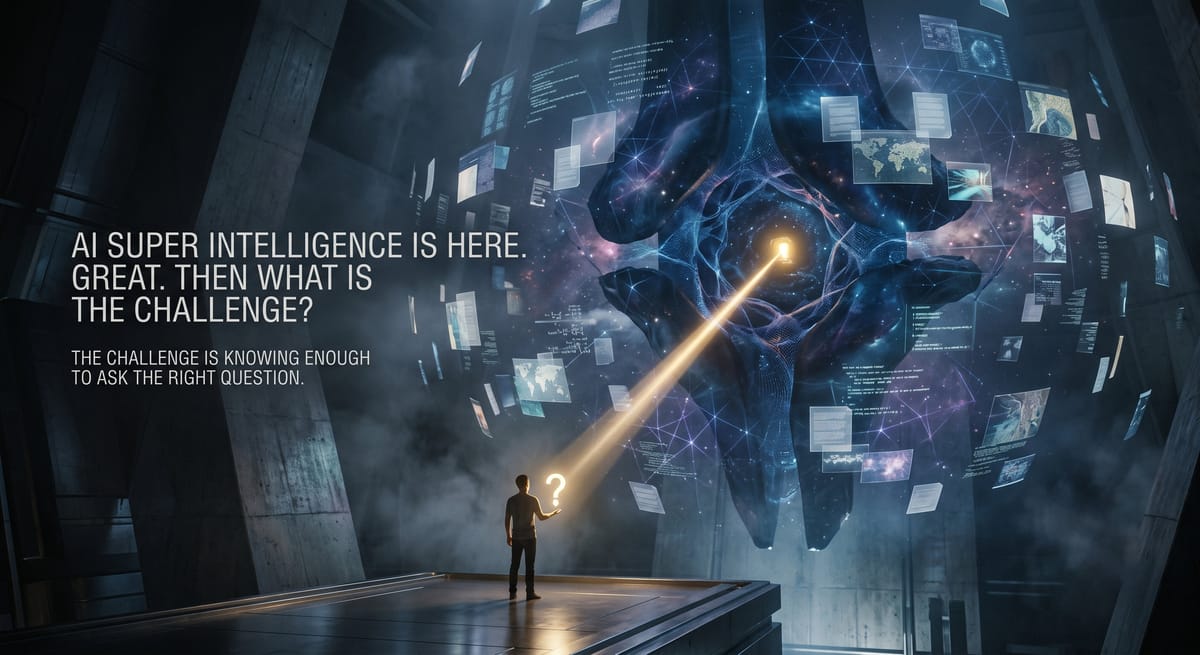
AI Super Intelligence is here, great, then what is the challenge ? we may have answer for everything !
Well, the key is not the answer, it is how much do you know to ask the right question?
The challenge is knowing enough to ask the right question
AI Super Intelligence or AI General Intelligence or AI Agents only make difference in any creator/innovator/Entrepreneur/Employee/Student life if and only if they know asking right question or in other words how much really do you know in specific domain or across domains to provide context and ask right question.
As a developer by profession and artist by passion I have come across different hype cycles of technology from Android App Development, Big Data, Blockchain, Data Science, informatics, 3D Printing, Machine Learning, Artificial Intelligence, AI Agents and AI Super Intelligence.
I would emphasis that, current and future AI Agents and AI Super Intelligence is totally different and certainly transformed the way software is produced and delivered given the generative coding.
In fact I would say AI Super Intelligence is already here given AI Agents, and behemoth LLMs
With AI Super Intelligence, what matters is how much do you know to ask right question
Answers are always there in universe for us to discover, we just don't know how to ask with or with out AI.
Do you know, regardless of how much powerful AI or AGI we have. Asking question like build this, give me that, work out this one really don't work.
This can also be explained as, how much intelligent you are to ask right question to make use of the Artificial Intelligence.
The more intelligent AI becomes, the more intelligent you must become to use it effectively—and to know the right questions to ask.
As AI becomes super intelligent, success belongs to those who know how to ask better questions. But, how can some one ask right question ? if you say "prompt engineering" No! That's merely patchwork and we hear it rarely now. It’s like giving a keyboard to a monkey and expecting it to produce a wonderful poem given enough time.
To explain what is meant by asking right question. Let me take you to the journey of cosmos!
All known super wise person named "AskWise" is traveling across the globe and meeting different people, and his field of expertise if space and to make it intersting, he is having magical power by which he can see through the spacetime and every corner in the vast expanding universe.
"When you have such a powerful person sitting beside you, what questions do you have to ask ?"
Let's go on a journey!
When Askwise met the toddler setting on the bench watching the night sky full of stars, toddler asked the question: "what are all those dots in the sky, combining them, they look like cat, and dog etc"
Given a toddler’s level of knowledge and intelligence, what kinds of questions is he genuinely capable of asking?
As Askwise traveling along the road on country side, a child found and recognised him as he is (Askwise) famous, asked him the few question
- Why does the Moon appear to change shape?
- What are stars made of ?
- Are there aliens ?
While brother of a child around 12 years old asked the questions
- How are black holes formed ?
- What is inside a blak hole ?
- Why is pluto is no longer called a planet ?
After wards a teenager in the group asked
- What is dark matter ?
- What happened before the Big Bang ?
- Is Time Travel Possible ?
- Why Universe is Expanding ?
While they are talking an adult passing by asked,
- What evidence support the Big Bang ?
- Does God Exist ?
- Are white holes real ?
- How to create and store dark matter ?
You can see, the questions we humans ask is limited by intelligence and knowledge we posses. Universe is full of answers but how much do we know and how intelligent we are, to ask right question. What are the "unknown unknowns"—the things we don't even know exist or we lack in knowledge and therefore don't know to ask about?
A knowledgeable teenager might ask:
- Why does gravity bend spacetime?
- What happens to information that falls into a black hole?
- Why is most of the universe apparently made of dark matter and dark energy?
- How can the universe expand if there is nothing outside it?
- Could the universe have existed eternally?
- What does quantum mechanics actually say about reality?
- Could time have started with the Big Bang?
- Why is there more matter than antimatter?
- Is time travel forbidden by physics or merely technologically impossible?
A university-level physics student might ask:
- How does Hawking radiation arise from quantum field theory in curved spacetime?
- What exactly is the black-hole information paradox?
- Can general relativity and quantum mechanics be consistently unified?
- What observational evidence could distinguish competing quantum-gravity theories?
- Is dark matter a new particle, a modification of gravity, or something else?
- What are the physical mechanisms behind cosmic inflation?
- Why does the cosmological constant have such a small but nonzero value?
- Is the arrow of time fundamentally connected to entropy?
A highly knowledgeable researcher might ask:
- What microscopic degrees of freedom account for black-hole entropy?
- Can the information paradox be resolved without violating locality or unitarity?
- Is spacetime fundamental or emergent?
- What observable signatures could distinguish eternal inflation from alternative cosmological models?
- Why does the Standard Model contain the particular gauge symmetries, particle content, and coupling constants that it does?
- What mechanism explains the hierarchy between the electroweak and Planck scales?
- Can quantum gravity make experimentally testable predictions at accessible energies?
- Is the apparent acceleration of the universe truly caused by a cosmological constant?
What you can ask is constrained by how much do you know !
Like wise,
Each had one chance to ask a question about space, galaxies, or the universe.
The child asked, "Why do stars twinkle?"
The teenager asked, "Are there aliens?"
The adult asked, "How did the universe begin?"
The engineer asked, "Can we build a spacecraft that travels faster than light?"
The scientist asked, "What existed before the Big Bang?"
The wise man answered every question with perfect clarity. Each person left amazed.
An old person who is observing everything, who had watched silently, smiled and said,
“The remarkable thing isn’t that he knows everything; it’s that none of us yet know the right question to ask.”
The AskWise nodded.
"Answers are easy when the right question is asked. The true challenge is discovering the question that reveals answers such as what you don't yet know."
The observer then asked, "If you know everything, what question would you ask yourself?"
For the first time, the wise man was silent.
Sometimes, the greatest mystery in the universe is not the answer.
It is knowing what to ask. The Question !
"The lesson I learned from The Hitchhiker's Guide to the Galaxy was that the hard part is figuring out what questions to ask, but once you figure out the question, then the answer is relatively easy."
-- Elon Musk
Now, coming back to Large Language Models trained with billions of parameter, trained on hundreds of thousands of GPUs, with every data ever produced on earth. The whole thing boils down to what question you ask given your intelligence and wisdom with LLM that knows everything to answer at disposal. Thus, the argument is more than ever LLMs demand us to be more intelligent, more wise and more experienced in the domain or across different domains enough to ask right questions relative to the time when there were no LLMs
Conclusion
People might think that with LLMs, artificial intelligence, and eventually super-intelligence, we will become freer and less burdened—that we can get away with learning less or upskilling less because AI will do most of the work for us.
But the opposite may be true.
AI is forcing us to learn more, not less. AI is forcing us to be inter-disciplinary. It is pushing us to continuously upskill, deepen our understanding, and develop better judgment so that we can use these powerful tools effectively. The more capable AI becomes, the more capable we need to become at directing, questioning, evaluating, and applying it.
AI can be a stone in the hands of a caveman or a chisel in the hands of an artist. The tool may be the same, but what it creates depends on the person wielding it.
“Even with AGI at our disposal, the hardest part isn’t finding the answer—it’s asking the right question.”