Opportunities Are Always There—Yet We Fail to See Them
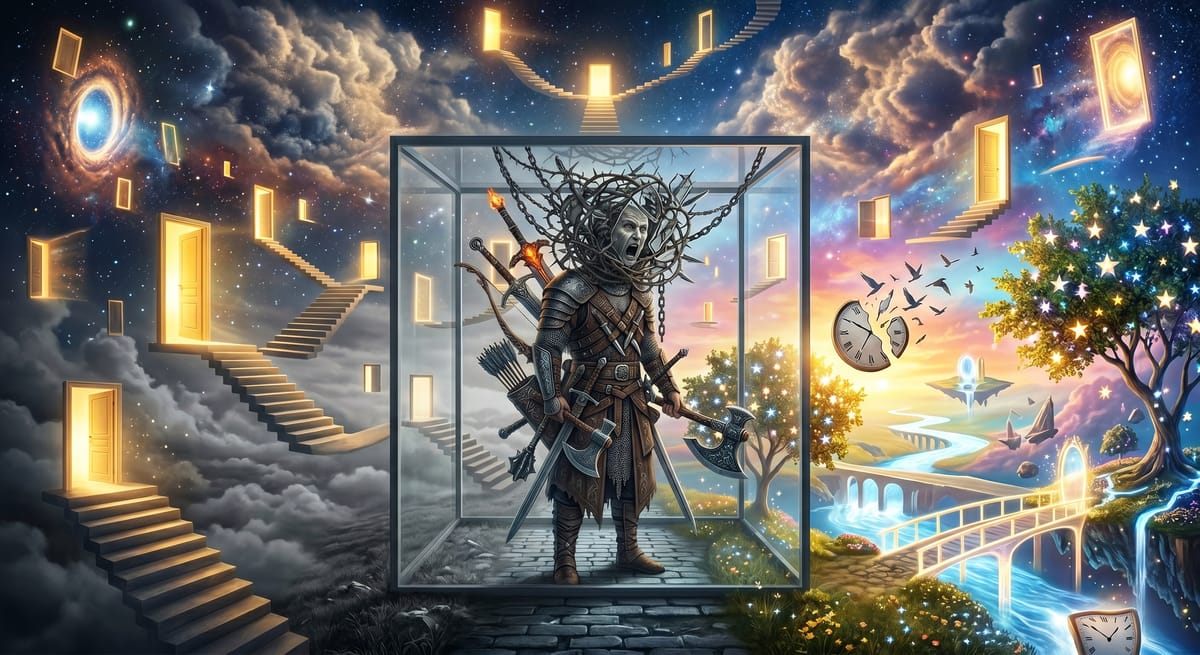
On June 2nd week 2026, I have visited the AutoNagar where all engineering, mechanical, manufacturing and repair shops are located in one place. Apparently I have visited there to learn about machining, as I'm going through one lathe workshop, I have stopped by as I have found the worker there who is very skill full, to ask him to teach me.
So, as I have went deep into the conversation about work with him. I'm astonishingly surprised to know he is having 20 years of experience an he would be around 35 year old and in current workshop he is working for 12 years. And, do you know how much he earns per day ? 600 INR ! regardless of the work or how much work he does. he takes home around 15,000 INR every month as salary even after 20 years of experience and being a skilled craftsman in machining. He comes every day 9 AM in the morning and leaves around 7 PM or sometimes 8 PM. So, what point here ? Let's see!
He even insisted and said multiple times
Never learn these skills, you would waste your life there is no future
We can see, he is having vast experience and very skill full yet he fails to see through what opportunities are out there for him with his skill set. With lathe, milling and machining skills he is having. despite being a skilled craftsman he earns till today after 20 years, 15k INR per month, as of writing this which is around $155 USD.
To given you context, his skillset is unique, not everybody can work or craft the metal like him, for analogy not every can disassemble and assemble vehicle but almost anybody can drive. And, only very few among who can repair or can put together craft the vehicle body out of blob of metal. He is among those very few.
So, I ask this question. Why he is poor while he is rich in skillset and experience ?
The only answer is, his awareness. Just like him lot of us lack of awareness can not comprehend the opportunities around us for us given our abilities, skills and experience.
We refuse to see or comprehend the opportunities life has for us simply because our mind has been held captive by lack of awareness. Ofcourse can also this awareness lacking as knowledge.
For instance, for centuries, doctors treated patients without washing their hands because they had no knowledge or awareness of germs or microorganisms. Many believed diseases were caused by bad air or other unknown factors, and infections after surgery or childbirth were common. In the mid-19th century, Ignaz Semmelweis observed that handwashing dramatically reduced patient deaths, but his findings were initially dismissed. Later, the discoveries of Louis Pasteur and Joseph Lister revealed that bacteria and other microorganisms cause infections, leading to the widespread adoption of hand hygiene. This breakthrough transformed medicine, making handwashing one of the most important practices for preventing disease and saving lives.
We need different lense to see or identify the opportunities life has for us. These lense become visible only by expanding our knowledge and only by expanding our our understanding of the world.
We perceive the world through different lenses. Some things are visible to the naked eye, others only through a microscope, a telescope. Each lens reveals aspects of reality that already exist but would otherwise remain hidden from us. Just as a microscope allows us to see microorganisms that are present all along, and a telescope reveals planets and stars that exist far beyond ordinary sight, different ways of seeing uncover new opportunities and insights. Every lens expands our understanding and makes our knowledge of the remarkable opportunities.
Coming back to the skilled machinist I met
- If he could tried, he could have got job at any manufacturing company
- He could create the art pieces from metal and sell them
- He could create and supply meta frames and supply them
- He can also become the CNC lathe operator
- He can make mold (injection or blow mold)
- He can teach his experience if not by offline through online with simple youtube channel. We can see some of the youtubers already doing
- Design and build product.
- Prototyping for Robotics
- Ship or boat building
- Creating machines for agricultural machines for locals
- Manufacturing of packaging machines
- Creating Steel Structures for construction
You can go on and list all of the opportunities.
Now begs the question, how to get lense to get awareness(knowledge) to see opportunities ?
Opportunities are alway there but we fail to see due to lack of lense. Then what is the lense?
The lense you need is the knowledge of interdisciplinary fields. The conventional wisdom says .......
Endless opportunities open up when you look thorugh interdisciplinary lense
The skilled machinist never recognising extent of his skillset, he has been doing same thing for years fixing trucks, tractor. Had he seen in different field asking question where else I can use my skill he would have seen the opportunities
The skilled machinist never fully recognises the extent of his abilities. For years, he has been repairing trucks and tractors, becoming highly proficient in his craft. Yet because he has spent so long doing the same work, he may not realize how transferable his skills are. If he were to look beyond his current field and ask, “Where else can I apply these skills?”, he would likely discover a wide range of opportunities and new career paths.
I quote Law 26 from the "The Diary of CEO"
Your skills are worthless, but your context is valuable. Your skills hold no intrinsic value; their worth is dictated entirely by the market context. You can exponentially increase your earning potential by migrating your existing expertise to a new industry where those skills are perceived as rare and highly valuable.
We can use "interdisciplinary" lense not only to find work opportunities but also to solve new problems or unravel new opportunities an Entrepreneur.
Let me life examples for people
Here are notable people whose impact came largely from interdisciplinary thinking—blending art, science, engineering, and design:
- Leonardo da Vinci — combined art, anatomy, engineering, and physics to create inventions and artworks centuries ahead of his time.
- Hedy Lamarr — merged acting with wireless communication theory, contributing ideas that later influenced Wi-Fi and Bluetooth.
- Steve Jobs — blended technology with design and typography to make computing deeply human-centered.
- Elon Musk — integrates aerospace, automotive engineering, AI, and energy systems across multiple industries.
- Buckminster Fuller — combined architecture, mathematics, and engineering to develop innovative structural designs like geodesic domes.
- Ada Lovelace — merged mathematics and imagination, laying conceptual foundations for modern computing.
- Maya Lin — blends architecture, sculpture, and landscape design in emotionally powerful public memorials.
- Brian May — combined astrophysics research with world-class musical creativity as the guitarist of Queen.
- Herbert A. Simon — integrated psychology, economics, and computer science to shape modern AI and decision theory.
When it comes to startups
Here are startups that emerged by unraveling new opportunities at the intersection of multiple disciplines (tech + finance, biology, design, logistics, etc.):
- Airbnb — blended technology, trust systems, and hospitality to turn homes into a global lodging network.
- Uber — combined mapping tech, mobile computing, and transportation logistics into real-time mobility.
- Stripe — merged software engineering with financial infrastructure to simplify global payments for the internet economy.
- Netflix — fused internet technology with traditional film distribution to transform entertainment consumption.
- Spotify — combined music licensing, recommendation algorithms, and streaming technology to reshape how people access music.
- SpaceX — integrates aerospace engineering, software, and manufacturing innovation to reduce the cost of space travel.
- Impossible Foods — blends biology, chemistry, and food science to recreate meat using plant-based ingredients.
- 23andMe — combines genetics, data science, and consumer software to make DNA analysis accessible to individuals.
- Palantir Technologies — integrates data engineering, security systems, and analytics to solve complex problems in government and enterprise.
- Duolingo — merges linguistics, gamification, AI, and education science to make language learning interactive and accessible.
- Robinhood — combines finance, behavioral psychology, and mobile UX design to simplify stock trading.
- Notion — merges database design, note-taking, and collaborative tools into a unified workspace.
- Figma — combines cloud computing, real-time collaboration, and design engineering for browser-based UI design.
- Canva — fuses graphic design, templates, and SaaS distribution to democratize design creation.
- Coursera — blends academia, internet platforms, and scalable video learning to democratize higher education.
Everything mentioned above fundamentally solved single specific problem by making use of interdisciplinary fields to produce the outcome or increase the earnings or bottom line